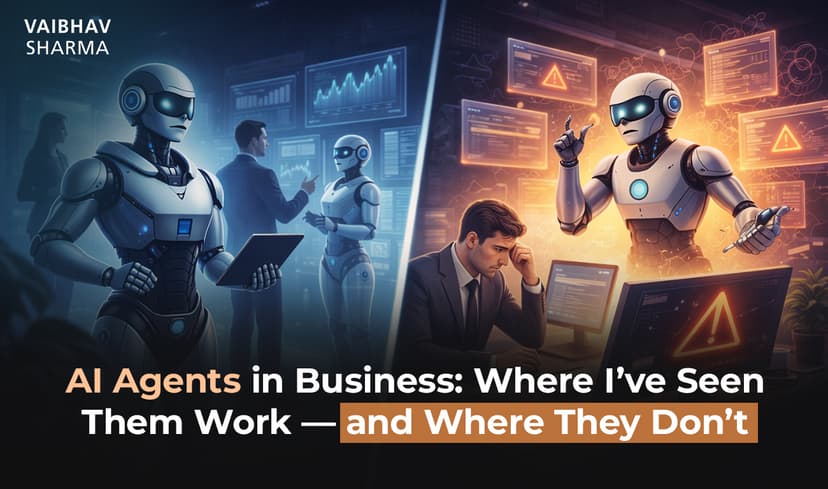
AI Agents in Business: Where I’ve Seen Them Work — and Where They Don’t
 10 min read
 Jan 23, 2026
Introduction
AI agents are one of the fastest-growing areas of interest. I’m often asked:
“Can AI agents run our workflows for us?”
Sometimes the answer is yes. Often, it is no — at least not yet.
This article explains how I evaluate AI agents for real business use.
What AI Agents Actually Are (in Practice)
In practice, AI agents are orchestrators, not autonomous employees.
They:
- Observe inputs
- Make conditional decisions
- Trigger actions across systems
They do not possess judgment, accountability, or context awareness.
Where I’ve Seen AI Agents Work Reliably
AI agents tend to work when:
- The workflow is repetitive
- Decision rules are explicit
- Data inputs are structured
- Errors are reversible
- Human overrides exist
Examples:
- Ticket routing
- Lead categorization
- Internal request handling
- Data synchronization tasks
Where AI Agents Commonly Fail
I advise against agents in workflows involving:
- Ambiguous decision criteria
- High financial or reputational risk
- Unclear ownership
- Poor data quality
- No rollback path
In these cases, agents introduce silent failure modes.
Guardrails I Require Before Deploying Agents
Before deploying an AI agent, I ensure:
- Human-in-the-loop checkpoints
- Full action logging
- Confidence thresholds
- Kill switches
- Clear accountability
Without these, agents should not be used in production.
Closing Perspective
AI agents can reduce operational load — but only when designed as controlled systems, not autonomous actors.
Next Step
If you’re considering AI agents, I offer an AI Agent Readiness Assessment to evaluate suitability and risk.
To access the framework, please fill out the request form on this page. Once submitted, the framework will be shared with you along with guidance on how to apply it within your organization.
AI agents are systems that observe inputs, make conditional decisions, and trigger actions across tools or workflows. They are orchestrators, not autonomous decision-makers.
AI agents work best in structured, repetitive workflows with clear rules, stable data, low risk, and defined human oversight.
Agents fail when applied to ambiguous decisions, high-risk workflows, poor data environments, or situations without rollback and accountability mechanisms.
No. AI agents replace specific repetitive decision steps, not roles. Humans remain responsible for judgment, oversight, and accountability.
Required guardrails include human-in-the-loop checkpoints, action logging, confidence thresholds, rollback mechanisms, and clear ownership of outcomes.
 By Vaibhav Sharma