
How to develop a practical AI strategy roadmap for mid-sized businesses?
 10 min read
 Feb 03, 2026
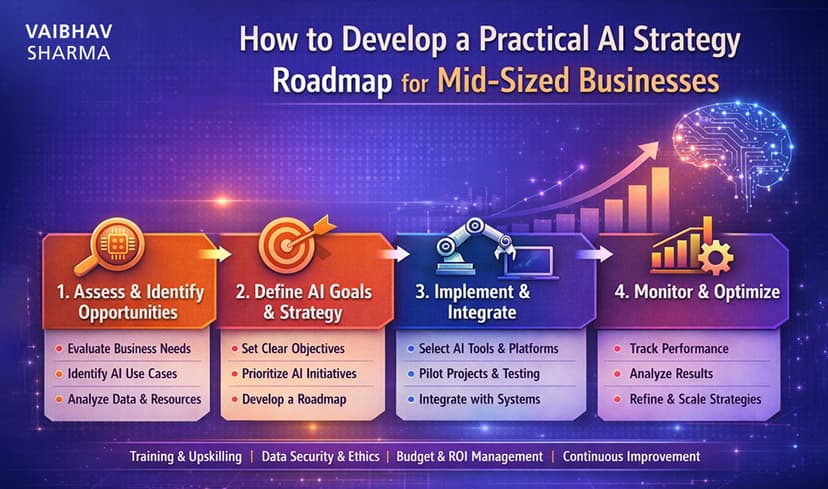
Most CEOs I talk to feel caught between two pressures: the board wants faster AI adoption, but their team knows they're not ready. That tension is real.
I've watched mid-sized companies burn through six-figure budgets on pilots that never scale. They'll spend months testing chatbots that don't integrate with existing systems or buy platforms that solve problems they don't actually have. The pattern is predictable—and expensive.
Here's what's different about the companies that get it right: they treat AI as a business strategy, not a technology experiment. The data backs this up—organizations with structured AI roadmaps report 25-50% time savings on routine tasks and hit production 40% faster than their enterprise counterparts.
But here's the reality most vendors won't tell you: 80% of AI investments fail to deliver measurable value. The problem isn't the technology. It's the approach.
Your finance team could close books three days faster through automated reconciliation. Support could deflect 30% of repetitive tickets through intelligent routing. These aren't theoretical benefits—I've seen them work. But only when companies start with business problems, not AI solutions.
Most mid-sized businesses actually have an advantage here. You can move faster than enterprises while having more resources than startups. The question is whether you'll use that advantage or waste it chasing the latest AI trend.
What would change if you assumed your biggest competitor already had their AI roadmap working?
The Three Things Every Mid-Sized Company Gets Wrong About AI Strategy
Why Mid-Sized Businesses Can Actually Win at This
Here's something most consultants won't tell you: mid-sized companies have a structural advantage in AI adoption. You're not burdened by enterprise bureaucracy, but you have more resources than startups trying to build everything from scratch.
Yet most mid-market firms waste this advantage. I see the same pattern repeatedly: 91% report using AI, but only 25% have actually integrated it into core operations. That gap between 'using' and 'integrating' is where most roadmaps break down.
The companies that close this gap see real results. Finance operations show 38% productivity gains. Back-office automation handles 70% of routine tasks like bookkeeping and invoicing. One client reduced operational costs by 30% within eight months—not through headcount reduction, but by letting people focus on higher-value work.
Strategy vs. Experimentation: What's Actually Different
Most companies are stuck running expensive pilots that never scale. MIT found that 95% of AI investments produce no measurable returns. The problem isn't experimentation—it's how it's done.
Real AI strategy looks different from pilot purgatory:
Experimentation approach: Buy tools first, figure out problems later Strategy approach: Start with business problems, then find the right AI solution
Experimentation approach: Run disconnected pilots across departments
Strategy approach: Build connected workflows that compound value
Experimentation approach: Measure AI performance metrics Strategy approach: Measure business impact metrics
The fastest-moving CEOs I work with stopped asking 'What can AI do?' They started asking 'What business problems cost us the most, and which ones could AI actually solve?'
What a Working Roadmap Actually Delivers
Your IT operations save 50% of routine work time. Data analysis tasks that took days now take hours. Customer service deflects 39% more repetitive requests.
But the real advantage isn't operational—it's strategic. You can handle increased transaction volumes without hiring proportionally. You can compete with larger companies' capabilities while maintaining your speed advantage.
Most importantly, a structured approach addresses the risks everyone worries about but few plan for: data privacy, security, and the ethical implications of automated decision-making.
The choice isn't whether to adopt AI. It's whether you'll do it strategically or become part of that 85% failure statistic.
The AI Readiness Trap Most Companies Fall Into
The Three-Layer Assessment That Actually Works
Forget complex maturity models for a moment. Start with three simple questions:
Can your data support AI decisions? Most companies discover their data is fragmented across departments, inconsistent in format, or just plain wrong. I've seen healthcare companies realize their patient records were 40% incomplete only after trying to build predictive models.
Can your systems handle AI workloads? Legacy infrastructure breaks under AI computational demands. If your current systems struggle with basic reporting, they won't handle machine learning.
Does your team understand what they're building? 52% of organizations lack AI talent. But the real issue isn't coding skills—it's business judgment about what problems are worth solving.
Where Most Assessments Go Wrong
The Gartner AI maturity model maps five levels from Awareness to Transformational. Most companies today sit at Level 1 (Awareness), which means they know AI exists but haven't implemented it yet.
But here's what the model doesn't tell you: jumping levels doesn't work.
I've watched companies try to leapfrog from Awareness to Systemic because they read about a competitor's success. They end up with expensive pilots that don't scale because they skipped the foundational work.
The Reality Check Your Team Needs
- Data silos: If your sales team can't easily access customer service data, you're not ready for cross-functional AI
- Skills deficit: You need someone who can translate between business problems and technical solutions
- Governance gaps: Without clear guidelines on data privacy and AI ethics, you'll get stuck in compliance review
Companies like Johnson & Johnson use 'skills inference'—AI systems that analyze employee capabilities and identify gaps. But most mid-sized businesses don't need that level of sophistication. You need honest conversations about what your team can actually execute.
The Assessment Framework I Actually Use
Evaluate your organization across six areas: Strategy, Infrastructure, Data, Governance, Talent, and Culture. But don't treat this as a one-time checklist.
Set up quarterly reviews to track improvement. Make it clear these assessments are for development, not performance evaluation. Otherwise, people will game the system and tell you what you want to hear.
The companies that get this right don't have perfect readiness scores. They have realistic assessments and concrete plans to address their gaps.
The Goal-Setting Mistake That Kills AI Projects
What companies get wrong about AI goals
Most mid-sized businesses fall into the same trap—they pick AI solutions before they understand their actual problems. I've sat in rooms where teams spend weeks evaluating chatbot platforms without anyone asking whether customer service inquiries are actually their biggest bottleneck.
The numbers tell the story: 95% of unfocused AI investments fail to deliver measurable returns. Yet companies keep making the same mistake.
They'll say things like 'We need AI to improve efficiency' or 'Let's use AI to enhance customer experience.' These aren't goals. They're wishes.
- What specific business problems need solving?
- How would we redesign workflows if cognitive tasks were nearly free?
- Which assumptions about our business no longer hold?
Why 'AI-first' thinking fails
The problem runs deeper than vague objectives. Many executives adopt what I call 'AI-first' thinking—they decide they need AI, then hunt for problems it might solve. This leads to expensive solutions that nobody asked for.
One manufacturing client spent $200K on an AI system that could predict equipment failures. Sounds smart, right? Except their real problem wasn't prediction—it was that technicians ignored maintenance alerts regardless of how they were generated.
The solution wasn't smarter algorithms. It was better workflows.
What works instead
Start with business outcomes, not AI capabilities. Map every potential AI project directly to revenue growth, cost reduction, or operational improvements you can measure.
- Cost reduction: actual dollar savings per month
- Customer impact: measurable changes in satisfaction scores
- Revenue growth: trackable increases in specific markets [46-49]
Since 80% of business leaders have less than 18 months to show AI results, vague goals aren't just wasteful—they're career-limiting.
Build a team that includes people who actually do the work. Not just department heads—the people who handle customer calls, process invoices, or manage inventory. They know where the real problems are.
Companies that connect AI initiatives to measurable business outcomes are three times more likely to see financial benefits. The successful 20% don't have better technology. They have clearer goals.
The Four-Phase Approach That Actually Works
Phase 1: Pick your first battle carefully
Your pilot project will set the tone for everything that follows. Choose wrong, and you'll spend months defending why AI isn't working. Choose right, and you'll have champions throughout the organization.
I use a simple framework: plot potential projects on business impact versus implementation difficulty. High impact, low difficulty wins every time. One client started with invoice processing automation—boring, but it freed up 8 hours per week for their accounting team and delivered ROI in 6 weeks.
The pilot should solve a real problem that keeps someone awake at night. Not an interesting technical challenge.
Phase 2: Scale what works, kill what doesn't
Most companies make the mistake of scaling every pilot. Don't. Only 30% of pilots should move to full deployment.
Here's my test: if the pilot doesn't show measurable time savings of at least 25% on routine tasks, it's not ready for scaling. Document everything—what worked, what broke, what surprised you. This becomes your playbook for the next deployment.
One healthcare client ran three pilots simultaneously. Two showed clear value, one didn't. They killed the third pilot and doubled down on the successful ones. That's how you build momentum.
Phase 3: Connect the dots across departments
This is where most roadmaps stall. You have isolated successes, but they don't talk to each other.
The key is governance—not the bureaucratic kind, but practical coordination. Someone needs to own the question: 'How do these AI tools share information?' Otherwise, you end up with data silos that actually make workflows more complicated.
Set up monthly cross-functional reviews. Sales, operations, finance—they all need to understand how their AI tools connect.
Phase 4: Build for continuous improvement
AI systems degrade over time. Data changes, business processes evolve, models drift. Plan for this from day one.
Track two types of metrics: technical performance (is the AI working?) and business impact (is it still solving the right problem?). The companies that get this right reassess their AI performance quarterly, not annually.
Budget at least 15% of your AI investment for ongoing maintenance and tuning. This isn't optional—it's the cost of keeping your competitive advantage sharp.
The budget reality no one talks about
AI costs are front-loaded and unpredictable. Your first-year budget will be wrong. Plan for it.
Set aside 10-20% contingency for the inevitable surprises: data preparation taking longer than expected, integration complexities, or compliance requirements you didn't anticipate.
Most importantly, budget for the human side. Training, change management, and building internal capabilities often cost more than the technology itself.
Here's what I'd do if I were in your position: start with one department, prove the model works, then expand. The alternative—trying to transform everything at once—is how you become part of the 74% that struggle to achieve value from AI initiatives.
What Actually Works When You Start Building
Pick Tools That Solve Your Problems
The fastest path to AI failure? Start with vendor demos instead of business problems. I've seen companies buy enterprise AI platforms before they know what they want to automate. Test tools against your specific use cases first. Consider three factors: how complex your tasks are, how fast you need results, and how much refinement the output requires.
For mid-sized businesses, the build-versus-buy decision matters more than you think. Vendor solutions integrate faster but lock you into their roadmap. Custom development takes longer upfront but gives you control.
Track What Matters, Not What's Easy
Most AI metrics are either too technical or too vague to drive decisions.
- Model performance - is it actually working?
- System reliability - does it stay working?
- Business impact - what changed in your P&L?
Companies using AI-specific KPIs are five times more likely to align their teams around the right outcomes. But here's the hard part: business impact often shows up months after technical success.
Use Software That Grows With You
Roadmap planning tools help, but only if your team actually uses them. Platforms like Aha.io now include AI assistants that help build timelines and track progress. They handle the administrative work while keeping changes visible across teams.
The key is picking tools that support iteration without breaking your workflow.
Build Internal Expertise Early
This is where most roadmaps break down. Teams assume they can figure out AI skills as they go.
Half your employees want formal AI training, but 92% of companies are increasing AI investments. That math doesn't work. Build structured upskilling programs now, measured using frameworks like the Kirkpatrick method. Focus on business applications, not technical theory.
Create AI champions in each department. They'll drive adoption faster than any mandate from leadership.
The Choice You're Actually Making
Key Takeaways
- Start with assessment, not tools - Evaluate your data quality, infrastructure, and team capabilities using frameworks like Gartner's AI maturity model before selecting any AI solutions.
- Align AI with measurable business goals - Connect every AI initiative to specific KPIs like cost reduction, revenue growth, or efficiency gains rather than pursuing 'AI for AI's sake.'
- Follow a phased implementation approach - Begin with 1-2 pilot projects, scale successful use cases, integrate across departments, then continuously optimize performance.
- Budget for ongoing costs and skills development - Allocate 10-20% contingency budget and invest in employee AI training, as 92% of companies plan to increase AI investments.
- Focus on business-first strategy - The 20% of companies achieving positive ROI from AI treat it as one tool in a larger business transformation, not as the primary objective.
FAQs
An AI strategy roadmap is a structured plan that outlines how a business will implement and scale AI technologies to achieve specific business outcomes. It's crucial for mid-sized businesses because it helps connect AI initiatives to measurable results, prioritizes resources, and creates a clear sequence of steps, increasing the chances of successful AI implementation.
Companies can assess their AI readiness by using frameworks like the Gartner AI maturity model, evaluating their data quality and accessibility, reviewing their infrastructure capabilities, assessing team skills, and identifying gaps in areas such as data silos, infrastructure limitations, and governance frameworks. Regular reassessment every six months is recommended to track improvement.
Key steps include starting with carefully selected pilot projects, evaluating and scaling successful use cases, integrating AI into cross-functional workflows, and planning for continuous optimization. It's also important to allocate budget for ongoing costs and unexpected expenses, typically 10-20% of the total AI budget.
Businesses should map specific AI initiatives directly to established business objectives such as revenue growth, customer satisfaction, or operational efficiency. It's crucial to set measurable objectives with specific KPIs, such as percentage reduction in costs or growth in regions where competitors haven't implemented AI, and avoid adopting AI tools without understanding how they solve specific business challenges.
 By Vaibhav Sharma