
How to Calculate ROI on AI Adoption: A Step-by-Step Framework
 10 min read
 Dec 16, 2025

About 92% of executives plan to increase their AI spending over the next three years. Yet organizations still struggle to measure these investments' actual value. Recent studies show that 49% of CIOs say proving AI's value blocks adoption. Even more concerning, 85% of large enterprises don't have proper tools to track ROI.
The gap is obvious. While 82% of organizations see AI as essential, measuring how it affects business remains difficult. Organizations usually underestimate AI implementation costs by 40-60%. This creates more pressure to prove value. But here's the bright side – when implemented correctly, ROI often shows up fast. Many legal AI applications deliver benefits within one to three months.
This is why we created a detailed framework to calculate AI ROI. This step-by-step piece will help you identify, measure, and communicate your AI initiatives' true value. You might be starting your first AI project or trying to justify existing investments. Let's change how you review AI's effect on your business.
Define What ROI Means for Your AI Project
Tangible vs. intangible returns
- Time savings through automated tasks
- Cost reduction via operational efficiencies
- Revenue increases from new AI-powered services
- Error reduction and risk mitigation
Intangible benefits (soft returns) prove harder to calculate but remain just as crucial. These cover improved employee participation, better customer experience, state-of-the-art solutions, brand growth, and skills acquisition. Many executives say AI often delivers valuable outcomes that don't easily translate to dollars.
Strategic, measurable, and capability ROI
- Measurable ROI: Direct, calculable impacts like cost savings and revenue increases
- Strategic ROI: Long-term organizational goals over a 3-5 year period, such as competitive advantage
- Capability ROI: Better overall AI maturity through skills development, specialized roles, and cultural readiness
This comprehensive view explains why traditional ROI calculations often miss the mark. Companies with considered, well-planned AI strategies double their chances of revenue growth compared to those focused only on quick returns.
Why defining success upfront matters
Clear success metrics before implementation make all the difference. Companies using well-defined KPIs to track AI success (41.9%) spot what works quickly and expand automation confidently. On top of that, 54.3% of CFOs want proof of AI's measurable value.
Success becomes nearly impossible without a clear problem to solve. Each AI initiative should start with a simple statement about the intended business outcome. Teams that check progress every 30-45 days keep their work in line with business goals.
Setting clear success metrics helps companies separate strategic AI initiatives from flashy projects that lack real business value.
Use a 5-Step Framework to Measure AI ROI
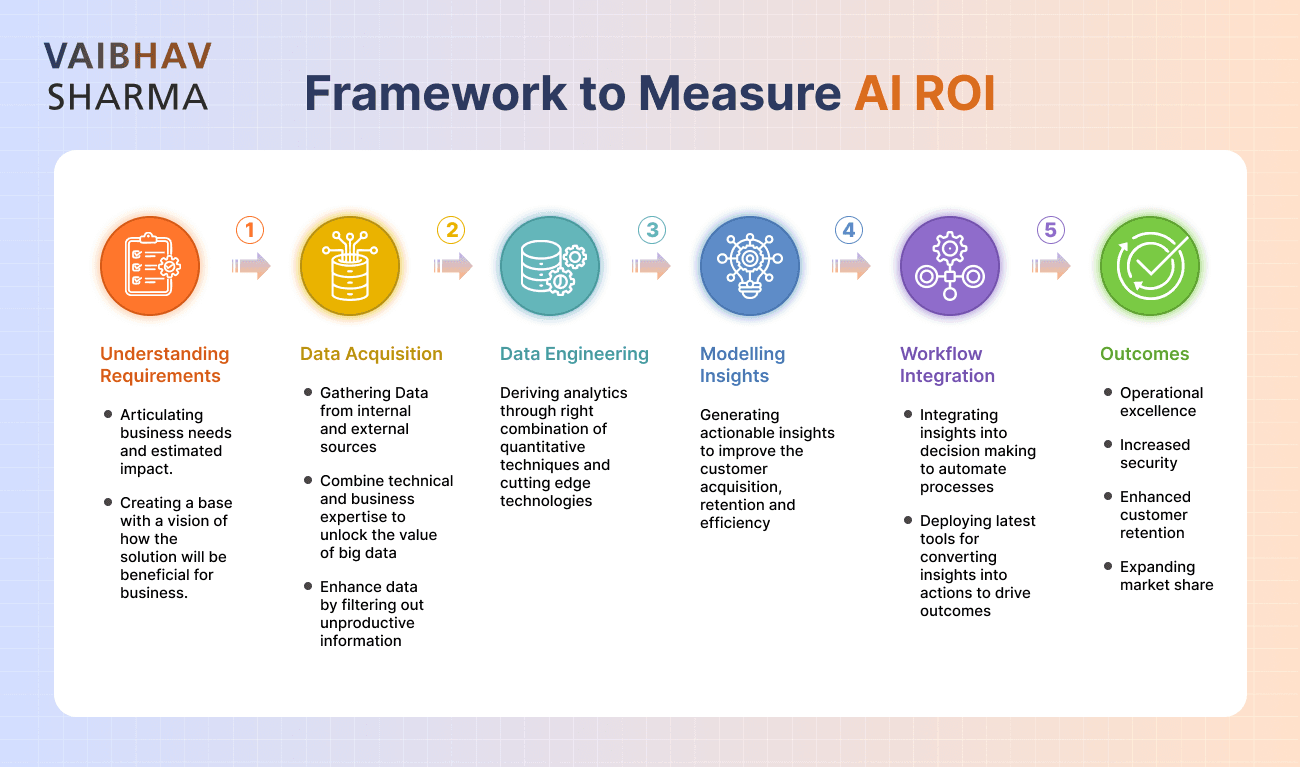
A systematic approach, not intuition, helps you measure AI investments effectively. Here's a 5-step framework that turns abstract AI value into real ROI figures, based on my success with AI projects.
1. Identify the workflow being improved
Your first step to generate financial results is to reimagine service or process delivery. Map out the complete service experience instead of using AI as a quick fix. Look for time-consuming repetitive tasks like data entry or invoice processing that add little strategic value. Your team should review current systems, spot areas where AI workflows could work better, and figure out what changes you need.
2. Set pre-AI baseline metrics
You can't calculate post-implementation ROI without solid pre-AI performance metrics. Document your current performance data - processing times, error rates, or response times. Get this information over 3-6 months to avoid unusual events skewing the results. Work out the averages, medians, and standard deviations to set an expected performance range. This baseline becomes your reference point to measure AI's success.
3. Forecast improvements using pilot data
Start with pilot projects to verify your AI's potential effect. Your focus during pilots should be on data that shows clear improvements over your baseline. A retail forecasting project reduced error rates from 37% to 26%. Another project brought in more than $350 million in leads for aftermarket parts and services. These early results help create realistic forecasts for full deployment.
4. Track post-implementation performance
Set up strong measurement practices with dashboards that show AI performance immediately. Create weekly and monthly reports to check business results over time. Add automated alerts when key metrics go beyond set limits. Companies with resilient infrastructure can track both technical performance and business outcomes.
5. Translate gains into financial ROI
The final step turns performance improvements into financial terms using this formula: Net Benefits = Total Benefits - Total Cost. A water treatment company boosted operations with digital scheduling. This led to 40% more technician capacity and 6% less overtime. Another company used GenAI for invoice-to-contract compliance and cut costs by about 10% across billions in spending. These financial results make a strong case for more AI investment.
Choose the Right Metrics for AI ROI Analysis
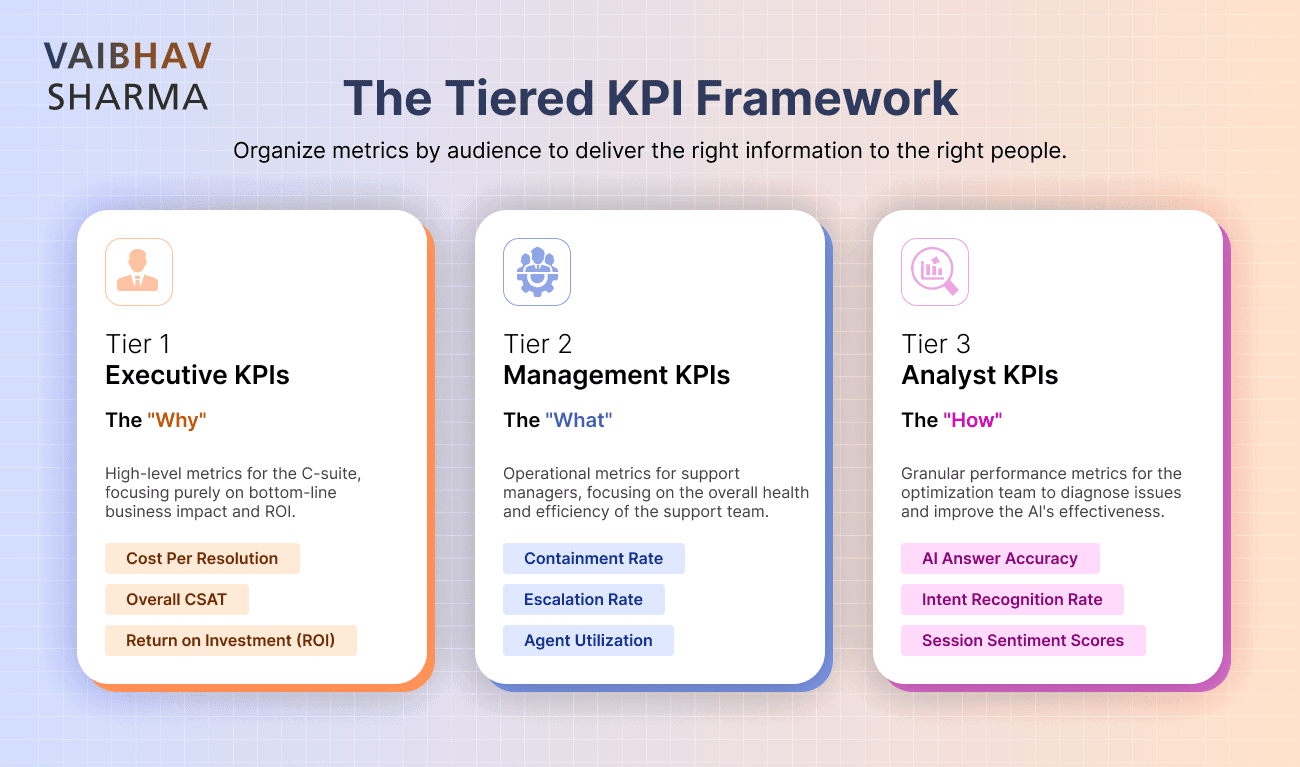
The right metrics will help you measure how well your AI investment pays off. Here's what you need to track based on thorough research:
Time savings and productivity
AI delivers clear benefits in saved time. Users save two hours each day on average, while some organizations cut task time by 80%. Large-scale AI projects boost labor productivity by 1.8% yearly. All the same, time savings change based on the task type. Healthcare tasks show 90% better efficiency, but hardware issues only improve by 56%.
Client or customer satisfaction
AI makes customer experience better through quick responses and personal touch. Companies track this using Customer Satisfaction Score (CSAT), Net Promoter Score (NPS), and Customer Effort Score (CES). AI tools can analyze customer feelings across channels with 98% accuracy. This gives live alerts about customer concerns. Companies see their NPS jump by 25-30 points after adding AI.
Cost reduction and financial impact
Money matters show up in direct savings and new revenue. Companies that use AI in operations cut costs by 20-30%. Procurement teams work 30-50% better. Marketing teams spend less while running more campaigns, and some save $10 million each year.
Risk mitigation and compliance
AI makes risk management stronger by spotting threats early. Companies keep track of how well they follow rules like GDPR and the EU AI Act. They measure drops in possible fines and penalties. Fraud detection systems look through huge amounts of data to find risks before they cause problems.
Innovation and agility indicators
Innovation tracking looks at new AI features released each quarter and staff trained in AI tools. Companies using generative AI get back 3.7 times what they spend. About 64% of companies say AI helps them innovate.
Communicate ROI to Stakeholders Effectively
Frame both short-term and long-term gains
The balance between quarterly targets and future transformation is significant. Organizations report a 74% success rate in achieving ROI within one year of launching AI initiatives. However, too much focus on immediate returns leads to dangerously short-sighted strategies. The best approach presents both points of view: immediate cost savings and growth opportunities. To name just one example, organizations using GenAI see an average 3.7x return on every dollar invested.
Use visuals and dashboards to show impact
Visual communication makes a dramatic difference in stakeholder understanding. AI-powered dashboards give immediate insights that adjust as new information flows in. Charts, graphs, and infographics work better than lengthy explanations, which helps stakeholders learn about ROI metrics quickly.
Compare AI vs. traditional methods
Comparative data shows how AI outperforms conventional approaches. AI-powered marketing gives 20-30% higher ROI compared to traditional methods. AI-boosted SEO achieves 22:1 returns while traditional SEO stays at 16:1. These side-by-side comparisons make the business case clear.
Highlight capability ROI and future readiness
AI projects do more than deliver immediate returns - they build organizational capabilities. Successful projects boost overall AI maturity through skills development and cultural readiness. The true AI revolution ended up being about more than improving existing work. It enables previously impossible achievements at cost structures that create sustainable competitive advantages.
Conclusion
Key Takeaways
- Define AI ROI across three dimensions: measurable (direct cost savings), strategic (competitive advantage), and capability (organizational AI maturity) to capture full value.
- Use a 5-step framework: identify workflows, establish baselines, run pilots, track performance, and translate gains into financial terms for systematic measurement.
- Track diverse metrics including time savings (average 2 hours daily per user), customer satisfaction improvements, and cost reductions of 20-30% in operations.
- Communicate ROI effectively using visual dashboards, comparative data showing AI vs traditional methods, and balanced short-term/long-term benefit presentations.
- Organizations with clearly defined KPIs and measurement frameworks are twice as likely to experience revenue growth compared to those without structured approaches.
FAQs
To calculate AI ROI, first define expected benefits and costs. Then use this formula: ROI (%) = (Net Benefits / Total Investment) x 100. Net Benefits are calculated by subtracting Total Investments from Total Benefits. Track both financial metrics like cost savings and non-financial impacts like improved customer satisfaction.
Important metrics include time savings (users save an average of 2 hours daily), customer satisfaction improvements (25-30 point increases in NPS scores), cost reductions (20-30% in operations), risk mitigation effectiveness, and innovation indicators like AI-enabled features released quarterly.
While results vary, 74% of organizations report achieving ROI within one year of launching AI initiatives. Some legal AI applications show benefits within 1-3 months. However, it's important to balance short-term gains with long-term strategic value when evaluating AI investments.
Use visual dashboards to show real-time impacts, present comparative data demonstrating AI's advantages over traditional methods, and balance short-term wins with long-term strategic benefits. Frame both immediate cost savings and future growth opportunities to give a comprehensive view of AI's value.
Start by clearly defining success metrics before implementation. Use a systematic approach like the 5-step framework: identify workflows, establish baselines, run pilots, track performance, and translate gains into financial terms. Choose diverse metrics across categories like productivity, customer satisfaction, and innovation to capture AI's full impact.
 By Vaibhav Sharma