
5 Signs Your Business Is Ready for AI Implementation (And 5 Signs You're Not)
 10 min read
 Dec 18, 2025
Most new AI projects don't succeed - statistics show an 80% failure rate. Companies have started embracing AI, with 75% using it in at least one business function. Yet fewer than 20% of organizations have built the essential practices needed to see real results.
Our experience shows AI's power to reshape businesses completely. Developer productivity can jump up to 200% with generative AI tools, according to McKinsey. Many companies still find it hard to tap into these benefits. Your organization's AI readiness shows how well you can roll out, run, and grow AI solutions across your strategy, setup, data, rules, people, and skills.
Success with AI needs proper groundwork. A solid assessment framework helps you spot if you're on the right track or likely to face expensive setbacks. The investment stakes keep rising - global AI spending could hit $300 billion by 2030. This piece breaks down five clear indicators that your business is AI-ready and five red flags you should fix first. You'll also find a practical checklist to check where you stand right now.
Strategic Alignment with Business Goals
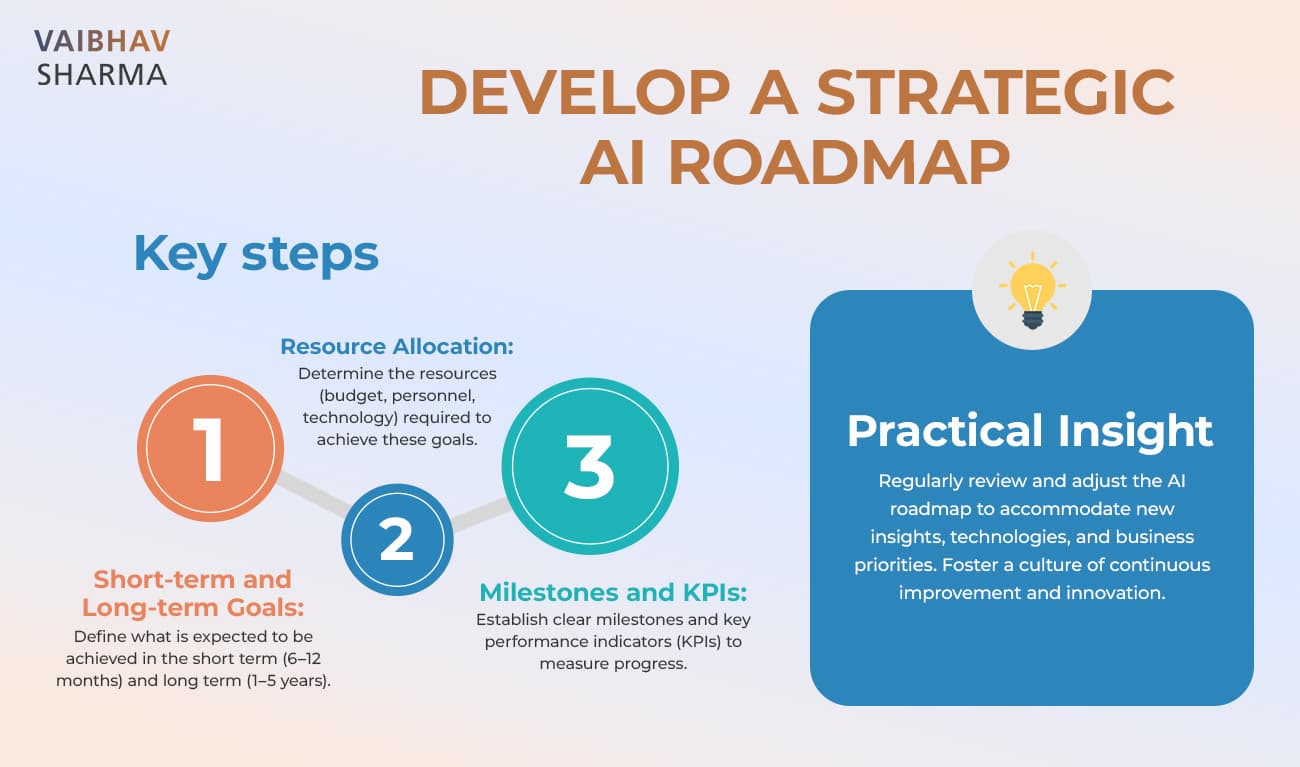
The right match between AI projects and business goals creates a strong foundation for success. Each AI project should directly contribute to specific, measurable business outcomes rather than deployment just for innovation's sake. A well-arranged AI strategy cuts operational friction, speeds up adoption, and builds regulatory resilience.
Definition
AI readiness means connecting artificial intelligence capabilities directly to your organization's core objectives and challenges. You need to select AI applications that address specific business needs, solve real problems, and deliver measurable results. Technology and business strategy must work both ways—business goals should shape the AI agenda while new AI capabilities should guide business direction. Without this connection, organizations might pursue random AI projects that waste resources without meaningful returns.
Readiness Indicators
- Leadership sees AI as a core strategy rather than an experimental project
- You set clear, measurable goals linked to specific KPIs before implementation
- AI governance frameworks ensure ethical use, transparency, and regulatory compliance
- C-level meetings regularly review AI initiatives to keep them connected with changing business priorities
- Technical and business teams work together on AI projects to represent both points of view
Organizations ready for AI can show how specific AI capabilities will solve identified business challenges—not just adopt technology because competitors do.
Warning Signs
- Vague or absent objectives: Nearly 95% of generative AI projects have either failed outright or had no measurable effect on business performance
- AI for AI's sake: Companies rush into implementation without clear, realistic goals or just from pressure to create something new
- Lack of leadership vision: Only 34% of data scientists reported well-defined project objectives before starting work
- Accountability vacuum: Problems grow worse without clear roles and responsibilities
- Unrealistic expectations: Organizations see AI as a 'magic bullet' to solve all problems instantly
Companies abandoning AI projects jumped from 17% to 42% year over year, highlighting the risks of rushing into AI initiatives without solid strategy.
Assessment Tips
- Use an AI-first scorecard to check your organization's AI adoption, architecture, and capability across departments
- Review regularly to ensure business strategy and AI initiatives stay aligned as market conditions change
- Test AI solutions with small-scale pilot projects before committing big resources
- Set clear success metrics and ROI expectations to keep stakeholder support
- Find specific business problems where AI offers measurable advantages instead of broad AI adoption
Note that AI implementation isn't about quick technology adoption—it's about building a foundation for lasting value that strengthens people to lead transformation.
Data Readiness and Accessibility
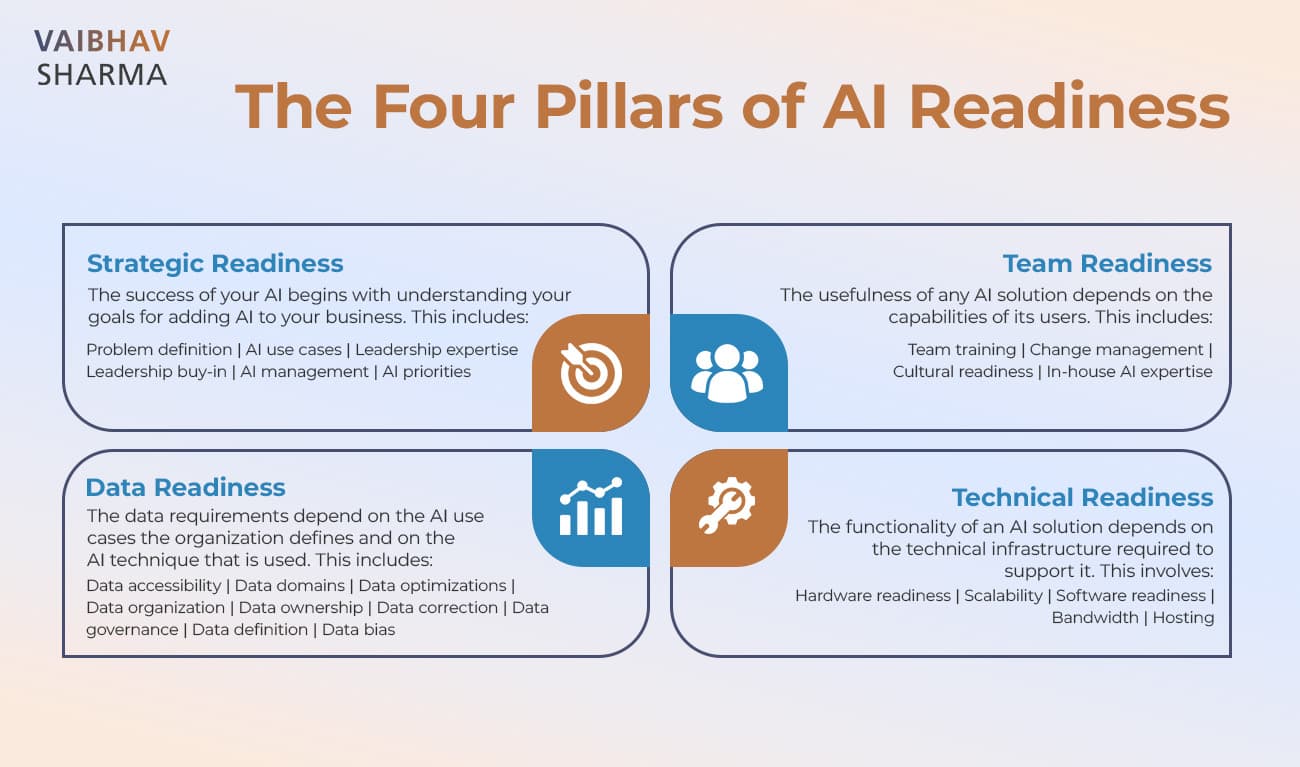
Quality data that's readily available builds the foundation of every successful AI initiative. Many AI projects fail because of data issues. Nearly 57% of leaders don't even understand what AI data readiness means. Organizations risk wasting resources on AI systems that produce flawed, biased, or harmful outputs without properly prepared data.
Definition
AI data readiness shows how prepared an organization is to implement strategies that make its data available and high quality. The data should be well-laid-out and match specific AI use cases. This extends beyond traditional data management since AI needs data representing every pattern. This includes errors and outliers that conventional analytics might remove. Data availability focuses on helping authorized users find, retrieve, and use needed data. This creates a balance between availability, security, and governance.
Readiness Indicators
- Properly scoped data that lines up with specific AI use cases rather than generic 'AI-readiness'
- Robust governance frameworks with clear roles, responsibilities, and processes to manage data assets
- Centralized data platforms that improve access and reduce inconsistencies
- Well-laid-out data catalogs that enable self-service data discovery
- Data qualified across multiple dimensions including validation, versioning, and continuous testing
Organizations that achieve proper data readiness can save up to 90% time in key processes and boost forecasting accuracy by 40%.
Warning Signs
- Data scientists spend 60-80% of their time to prepare and clean data manually
- Information stays trapped in departmental silos without a single source of truth
- Teams disagree on simple definitions and use different terms for identical concepts
- Data synchronization needs hours or days, which prevents immediate insights
- Your organization hasn't audited data for accuracy, completeness, or potential bias
Companies facing these issues often see poor AI performance. Errors grow exponentially as bad data flows through AI systems.
Assessment Tips
- Run a structured assessment on five key dimensions: data availability, volume and diversity, quality and integrity, governance, and ethics/responsibility
- Review data against your specific AI use cases instead of pursuing generic 'AI-readiness'
- Check data health using metrics like completeness, timeliness, uniqueness, integrity, availability, and error rates
- Pick and prioritize gaps based on strategic impact, potential ROI, and resource availability
- Create remediation plans with specific, useful steps to address each issue
Note that AI-ready data doesn't mean perfect data. Your data should represent the specific use case and include necessary patterns, errors, and outliers.
Technology and Infrastructure Scalability
Definition
Organizations need to know how to expand their technical systems, cloud platforms, and tools as their AI applications grow. This ability to scale includes hardware, software, and network components that process massive data volumes, train complex models, and run AI workloads smoothly. A well-planned infrastructure will give organizations room to adapt to changing computational needs without rebuilding their entire technical foundation.
Readiness Indicators
- Cloud-based or hybrid environments that blend deployment across on-premises, cloud, and colocation centers
- GPU-accelerated computing and high-performance storage that support resource-intensive AI algorithms
- Secure data pipelines with strong security protocols and compliance enforcement
- Feature stores that help reuse features across different ML models
- Specialized AI and ML tools that blend with existing IT infrastructure
- MLOps frameworks that streamline model deployment and maintenance
Organizations serious about AI infrastructure put about 51% of their tech budgets into cloud and AI technologies. This shows their steadfast dedication to building adaptable foundations.
Warning Signs
- Networks can't handle complexity or data volume (36% of organizations report this)
- Networks lack flexibility (only 9% of companies call their networks adaptable enough)
- Data silos block centralized access (66% of organizations face this)
- GPU capacity falls short (only 23% have strong GPU capabilities)
- AI-specific threats go undetected (only 21% can spot these)
- Response times slow down due to performance issues
- Training jobs sit in queues for hours or days
Assessment Tips
- Run a capacity planning assessment to forecast compute needs based on model complexity and data volume
- Track GPU utilization rates—both peak and average—to spot potential bottlenecks
- Measure network bandwidth and latency metrics throughout your infrastructure
- Test scalability under various scenarios
- Check if your cloud strategy can handle changing AI workloads
- See how well your organization can use MLOps practices for ongoing model management
Smart organizations build flexible architecture that grows with their AI needs. This approach helps them avoid infrastructure debt that can reduce AI value later
AI Talent and Skills Availability
Definition
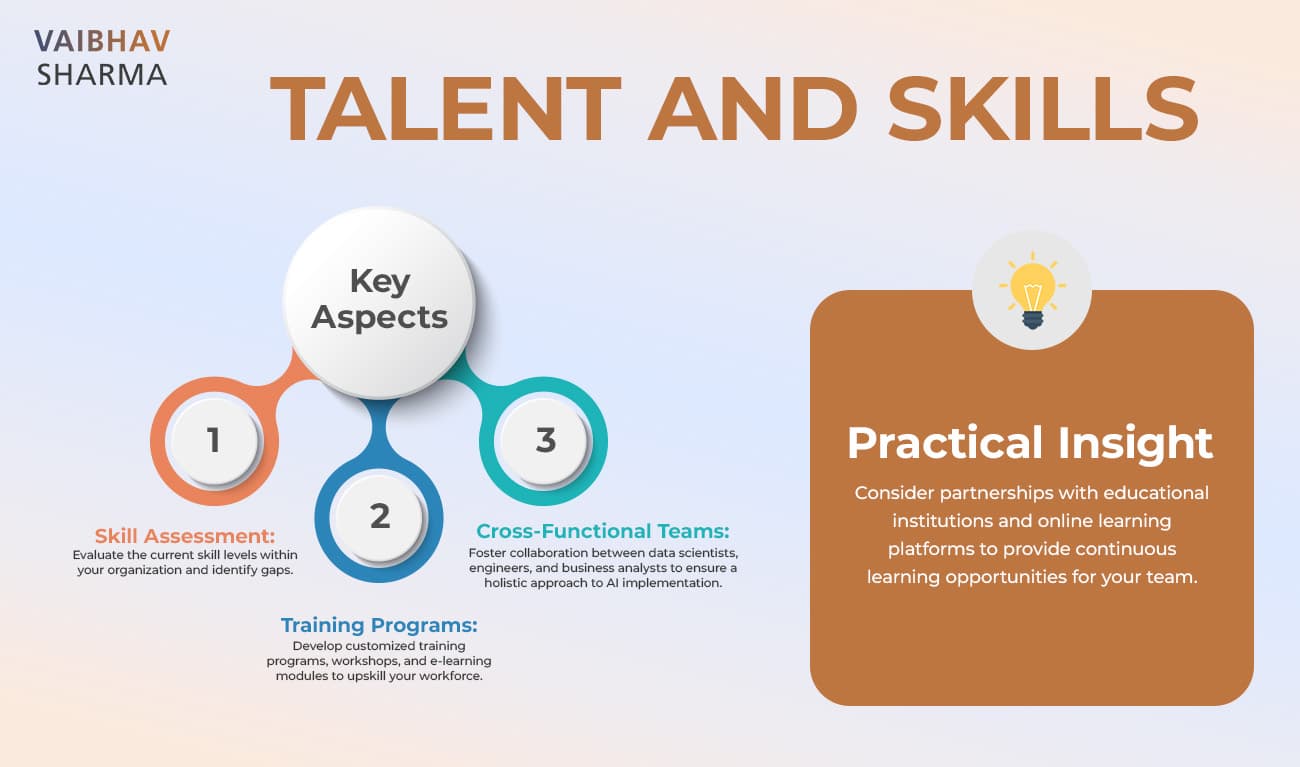
AI talent and skills availability shows how well an organization can find professionals who develop, implement, maintain, and work together with AI systems. This includes both technical AI skills (machine learning, deep learning, natural language processing) and human abilities like critical thinking, problem-solving, and ethical judgment. A company's AI talent readiness also depends on having the right structures and learning systems to build these skills as technology changes.
Readiness Indicators
- Employees understand AI and can express its strengths, weaknesses, and risks
- Millennials (35-44 years old) lead the way as AI champions, with 66% answering AI questions from their teams weekly
- Teams balance technical expertise with human skills (ethics, empathy, contextual judgment)
- Clear paths exist to develop AI skills at every level
- Managers act as 'growth mindset coaches' to support AI adoption
Warning Signs
- Executives don't realize how much employees use AI (thinking only 4% use it extensively when real usage is three times higher)
- One-fifth of employees get little or no AI support or training
- Over 70% of CHROs think AI will replace jobs within 3 years, which creates resistance
- Companies focus only on technical skills and ignore human capabilities
- Employees show resistance or doubt about AI instead of curiosity
Assessment Tips
- Run a skills gap analysis for AI capabilities across departments
- Rate employees on four levels: unacceptable (resistant), capable (simple use), adoptive (regular integration), and transformative (reimagining processes)
- Use direct questions like 'What AI tools are you currently using?' and 'How do you verify AI outputs?'
- Look at both technical skills and human abilities
- Check if managers can help their teams through AI changes effectively
Successful organizations know that AI implementation needs more than just technical experts. They need to upgrade about 40% of their workforce's skills over the next three years. The goal is to promote a culture where employees see AI as a tool that increases their capabilities rather than a threat to their jobs.
Governance and Ethical AI Practices
Definition
AI governance creates guidelines for ethical, transparent, and secure AI use. It helps organizations stay compliant, accountable, and make responsible decisions in their AI projects. The framework has policies for transparent AI decisions, data handling rules, ethical guidelines, and ways to follow regulations. A complete governance structure works on multiple levels. It needs a policy team to set regulatory goals, an ethics board to make policies, business unit representatives to check use cases, and advocates to build an ethical AI culture.
Readiness Indicators
- AI ethics committees with defined roles and duties
- Clear steps for AI decisions, explanations, and accountability
- Regular checks to spot and fix algorithmic bias
- AI risk management built into cybersecurity plans
- Rules for handling sensitive data in AI training (only 40% of businesses do this)
- Written steps for managing AI incidents (only 29% of organizations have these)
- Rules that match recognized frameworks like UNESCO's AI Ethics Guidelines
Warning Signs
- Nobody owns AI ethics ('Data Science blames Compliance, Compliance points to IT')
- No formal control over AI use (53% of organizations miss this)
- Anyone can use AI without checks (78% of businesses face this issue)
- Teams can't explain AI decisions ('How did we reach that conclusion?')
- No system to track problems or handle AI incidents
Assessment Tips
- Matching your ethics policies with UNESCO's core values - fairness, transparency, safety, and accountability
- Making sure governance grows with your AI projects
- Using UNESCO's RAM to check legal, regulatory, and ethical aspects
- Linking AI governance to your existing systems like data governance and risk management
- Ensuring everyone knows their role in keeping AI ethical
| Governance Element | Ready Organization | Unready Organization |
|---|---|---|
| Ethics Policy | Lives in daily work, updates often | Sits in a drawer, rarely used |
| Incident Management | Clear steps for AI problems | No plan, just reactions |
| Data Handling | Strong rules for private data | Fuzzy boundaries and permissions |
Cultural Readiness and Change Management
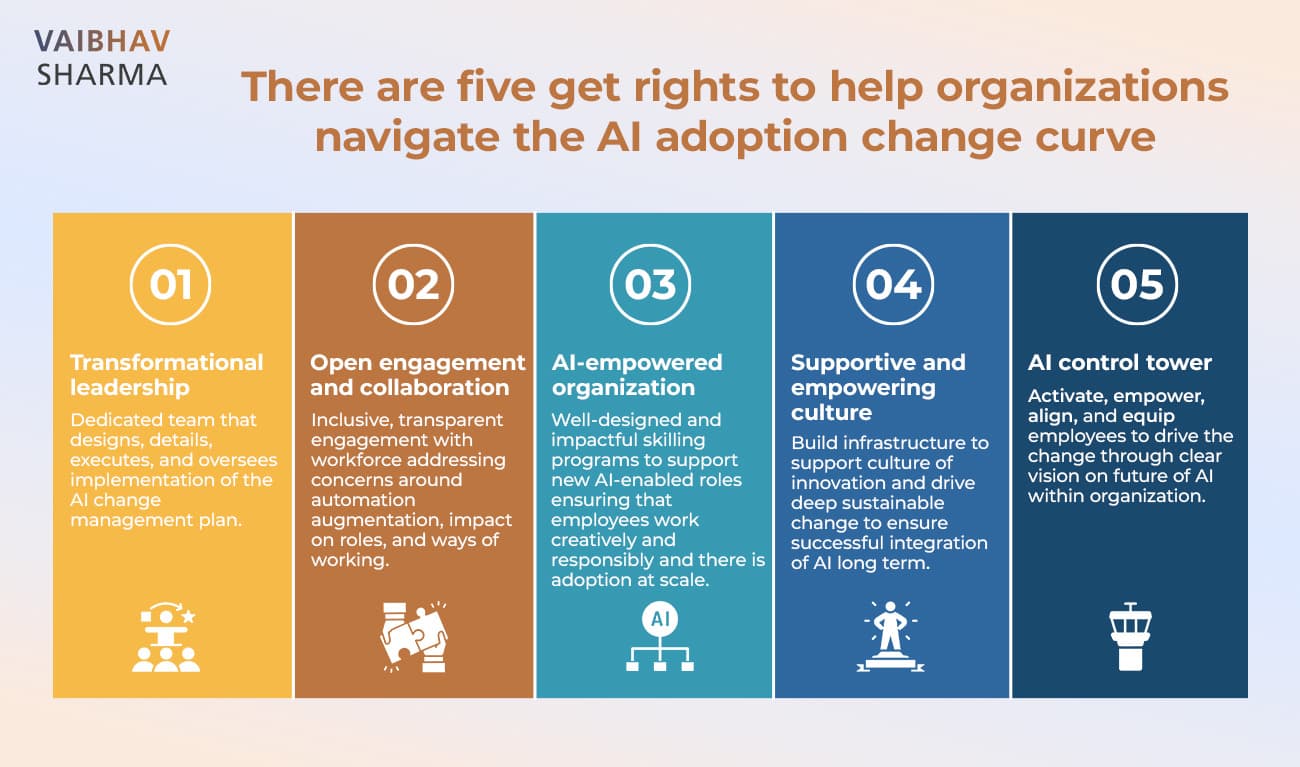
Cultural transformation determines AI implementation success. Traditional change initiatives fail 70% of the time. Companies that integrate AI in their change management approach see 40% higher adoption rates and 25-30% faster implementation timelines.
Definition
An organization's cultural readiness for AI shows in its knowing how to accept change, encourage innovation, and support employees through the transition to AI-improved workflows. Change management focuses on implementing and sustaining these changes. Modern AI-driven environment requires organizations to evolve beyond being 'change-ready.' They must become 'change-seeking' and proactively identify opportunities before disruption makes it necessary.
Readiness Indicators
- Long-standing psychological safety that supports informed risks and AI experiments
- Curiosity culture that spots new ideas and unmet needs early
- Transparent communication in multiple channels with feedback opportunities
- Learning through failure mindset that reduces penalties for unsuccessful tries
- Leadership modeling that demonstrates ethical and strategic AI use firsthand
Note that change-seeking cultures don't wait for change. They initiate it and position learning and development as the neural network of transformation.
Warning Signs
- Leadership lacks vision (only 36% of leaders fully embrace AI as core to strategy)
- Employees resist due to job security fears or ethical concerns
- AI training remains absent (47% of employees report receiving none)
- AI projects stay isolated instead of becoming part of organizational DNA
- Teams mistrust AI outputs—often a valid concern
Assessment Tips
- Leadership capability assessment shows importance—71% of senior leaders now call the ability to lead through constant change critical, up from 58% last year
- Psychological safety assessment reveals willingness to experiment and learn from setbacks
- Communication effectiveness measurement matters—employees who strongly agree leaders have communicated clear AI implementation plans are 2.9 times more likely to feel prepared
- Training programs need review for technical literacy, workflow integration, and ethical awareness
| Element | Ready Organization | Unready Organization |
|---|---|---|
| Leadership Approach | Models AI use, openly experiments | 'Wait and see' stance |
| Learning Environment | Rewards innovation, tolerates failure | Penalizes unsuccessful attempts |
| Communication | Transparent, multi-channel | Top-down, limited |
Financial Planning and ROI Forecasting
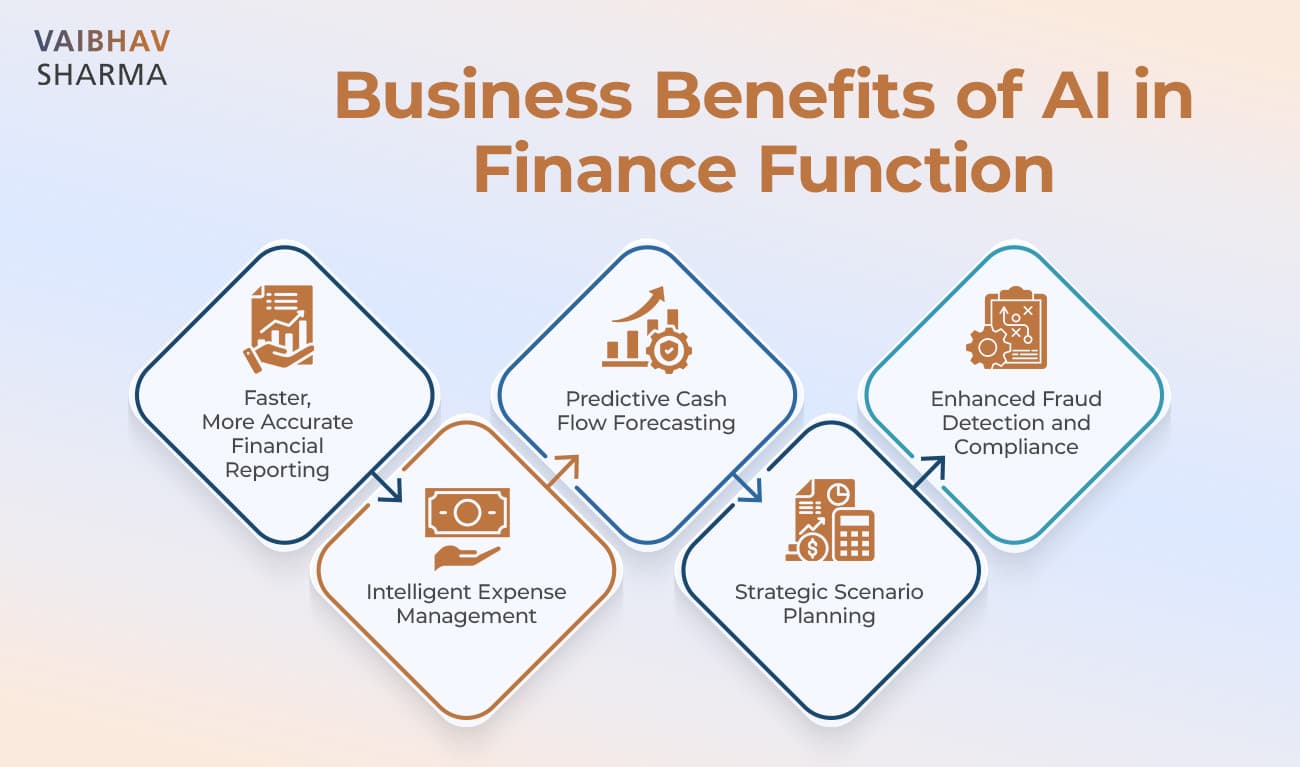
The difference between successful AI initiatives and resource-draining failures lies in proper financial planning. Studies show that all but one of these AI pilot projects fail to show any clear financial savings or profit increases. This stark reality shows how crucial financial preparation becomes.
Definition
Financial planning and ROI forecasting for AI readiness covers budgeting for AI initiatives, setting clear financial success metrics, and creating realistic timelines for expected returns. Organizations must move beyond vague expectations and define specific, measurable outcomes that line up with business objectives. Smart AI financial planning weighs the original investment against long-term value creation while factoring in hidden costs like data preparation, infrastructure upgrades, and workforce training.
Readiness Indicators
- Defined success metrics that connect to specific business KPIs instead of technical achievements
- Realistic ROI timelines that acknowledge AI projects need 6-12 months to deliver results
- Phased implementation approach that puts high-value, low-risk pilot projects first
- Preference for buying over building AI solutions (bought AI tools succeed 67% of the time compared to one-third for internal builds)
- Continuous measurement processes to track performance against set metrics
Note that change-seeking cultures don't wait for change. They initiate it and position learning and development as the neural network of transformation.
Warning Signs
- Success metrics remain unclear with no specific KPIs
- Timeline expectations demand ROI within 6-12 weeks instead of months
- 'People costs' get overlooked, including training and process redesign
- ROI estimates based on pilots miss enterprise-wide scaling challenges
- Heavy infrastructure spending happens without deployment or adoption plans
Assessment Tips
- Split ambitious goals into measurable targets (e.g., 'auto-resolution of 40% of password resets' instead of 'automate all customer service')
- Measure both direct financial effects (revenue, margin) and operational efficiencies (throughput, cost per unit)
- Clean data initiatives should come before major AI investments because messy data ruins everything
- Deploy AI on back-end processes rather than limiting it to marketing and sales applications
- Use MLOps to bring discipline and consistency to AI processes
| Element | Ready Organization | Unready Organization |
|---|---|---|
| Success Metrics | Clear KPIs tied to business outcomes | Vague technical achievements |
| Investment Approach | Phased with pilot validation | 'Big bang' implementation |
| Timeline Expectations | Realistic (6-12 months) | Unrealistic (6-12 weeks) |
Integration with Business Processes
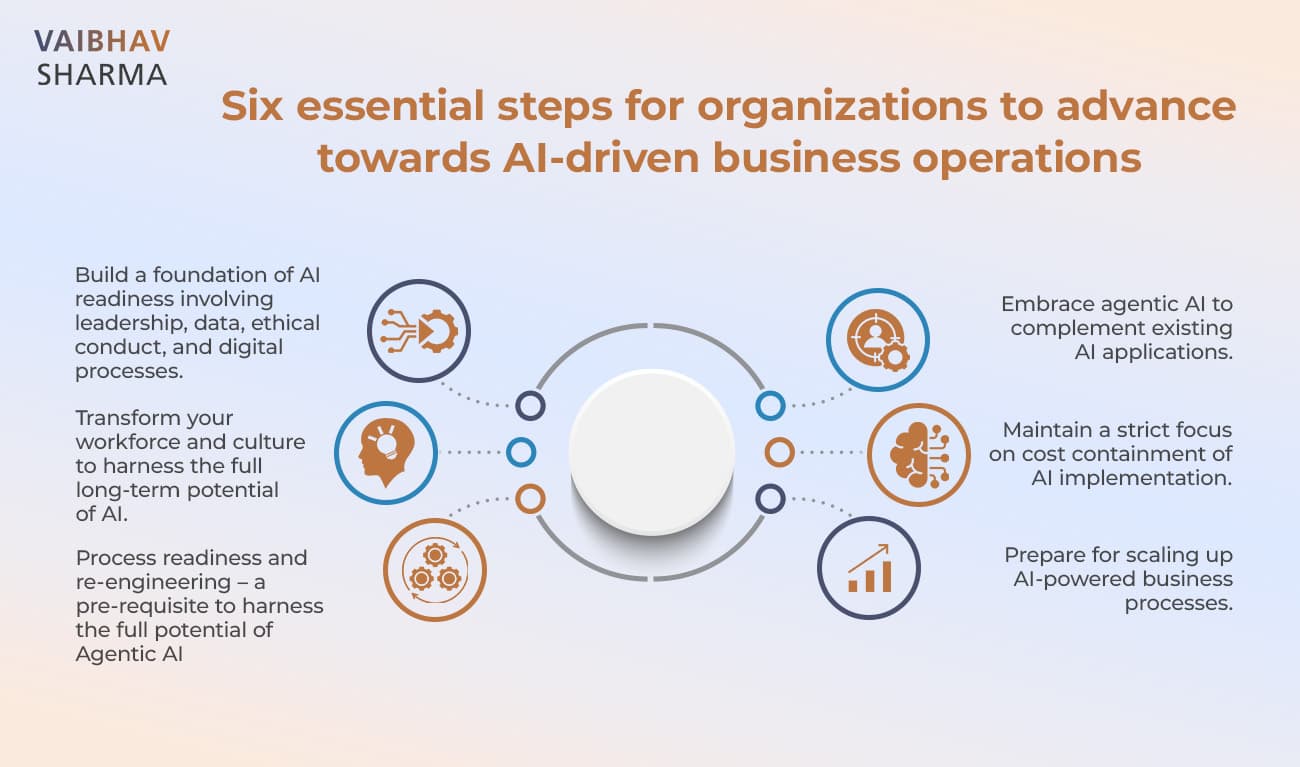
AI integration with existing business processes remains the biggest challenge during implementation. Many organizations see their AI projects stall or fail at the integration stage. These problems are systemic and account for much of the 95% failure rate in generative AI projects.
Definition
Business process integration means combining AI capabilities smoothly into existing workflows, systems, and applications instead of using AI as a standalone tool. The process needs AI models to connect with current business systems like CRMs, ERPs, databases, and APIs. When done right, AI becomes a natural part of how work happens and enhances 10-year-old operations.
Readiness Indicators
- Automated data pipelines that move toward live or near-live data ingestion
- Well-defined handoff points between AI systems and human workflows
- Lightweight APIs or middleware that link modern ML outputs to legacy systems
- Clear security protocols at each integration point to protect sensitive data
- Cross-functional integration teams that combine technical and domain expertise
Warning Signs
- Legacy systems can't support live predictions or continuous data streams
- Infrastructure mismatches cause latency and performance issues
- No clear plans exist to modify current workflows for AI
- Integration plans missing during vendor selection and pilot phases
- Security gaps at integration points expose customer's sensitive data
Assessment Tips
- Document current workflows before AI integration to map exact handoff points
- Start with small pilot projects in manageable areas to test different approaches
- Review API capabilities of existing systems to find connectivity options
- Check security protocols at integration touchpoints
- Look at explainability needs to make sure teams understand integrated AI decisions
| Element | Ready Organization | Unready Organization |
|---|---|---|
| Data Pipelines | Automated, near real-time | Manual, batch-oriented |
| System Connections | Well-defined APIs | Ad-hoc connections |
| Workflow Mapping | Clearly documented | Undefined handoffs |
Monitoring and Maintenance Capabilities
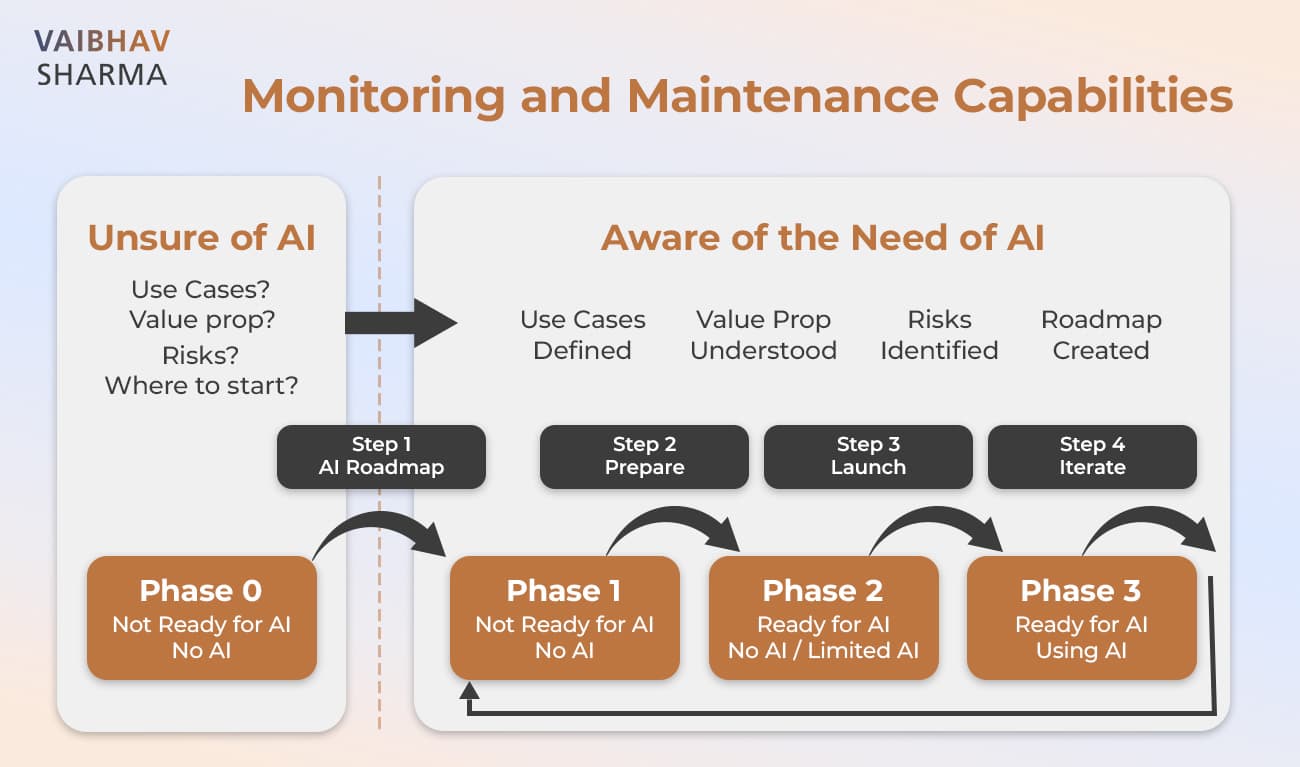
AI systems need constant monitoring and maintenance to achieve long-term success. Models can 'drift' and their performance may deteriorate over time. Traditional software differs from AI because it needs specialized oversight to ensure proper system performance.
Definition
Organizations must know how to track AI model performance continuously. They need to spot anomalies and make timely updates or corrections. The process has sections for setting standard metrics, using automated monitoring tools, and developing ways to retrain and refine models. These capabilities help AI systems stay accurate, efficient, and lined up with business goals when conditions change.
Readiness Indicators
- Automated monitoring frameworks that give up-to-the-minute data analysis of system health and performance
- Standard metrics set as a basis to measure ongoing performance
- Anomaly detection systems to spot unusual patterns that might signal problems
- Regular data integrity checks to confirm quality and consistency of input data
- Drift detection mechanisms to identify inconsistent model outputs
- Well-laid-out incident response plans to handle AI system failures
Warning Signs
- Missing performance metrics like accuracy, precision, and recall
- No systems to detect model drift
- Poor documentation about AI model behavior and decision-making
- No incident management protocols for AI failures
- Models that can't explain their specific outputs
Assessment Tips
- Clear standard metrics before deployment
- Non-stop monitoring with automated alerts
- Drift detection tools to watch performance changes
- Detailed incident response steps
- Feedback loops that drive continuous improvement
| Element | Ready Organization | Unready Organization |
|---|---|---|
| Performance Tracking | Automated, real-time | Manual, infrequent |
| Drift Detection | Proactive monitoring | Reactive or absent |
| Incident Response | Structured process | Ad-hoc approach |
People Also Ask: Common Questions About AI Readiness
Business leaders need to understand several key questions before starting their AI journey. A well-laid-out assessment framework helps companies avoid joining the 95% of AI projects that fail to show measurable results.
What is an AI readiness assessment checklist?
A diagnostic tool called AI readiness assessment checklist helps determine if an organization can adopt and scale AI successfully. This structured framework measures data quality, infrastructure, talent, strategy, and governance. The most effective checklists look at four key factors: organizational readiness, state of enterprise data, technical capabilities, and change threshold.
How do I know if my business is AI-ready?
Your business shows AI readiness when it excels in six critical areas: Strategy, Infrastructure, Data, Governance, Talent, and Culture. You need to check if your data is accurate, accessible, and responsibly governed. Your systems should handle AI workloads and your teams must have the right skills. Security preparedness needs attention too, since only 6% of organizations have an advanced AI security strategy.
What are the risks of poor AI readiness?
- Data exposure: 49% of IT leaders name this their biggest concern
- Ethical and reputational damage: Biased algorithms or discrimination
- Regulatory non-compliance: 55% of organizations aren't ready for AI regulatory compliance
- Operational inefficiencies: Implementation becomes scattered without clear direction
- Security vulnerabilities: 64% of organizations lack full visibility into their AI risks
What is an enterprise AI readiness assessment?
Enterprise AI readiness assessment gives a complete picture of organization-wide preparedness through seven key pillars: Business Strategy, AI Governance, Data Foundations, AI Strategy, Organization & Culture, Infrastructure, and Model Management. This assessment helps leadership spot gaps, set investment priorities, and build confidence in AI initiatives, unlike department-level reviews.
AI Implementation Readiness Assessment Matrix
| Readiness Aspect | Key Readiness Indicators | Warning Signs | Assessment Metrics |
|---|---|---|---|
| Strategic Alignmen | - Leaders see AI as a must-have- Goals tied directly to KPIs- Teams working together across functions | - 95% of projects show no real results- Unclear or missing goals- Leaders lack direction | - AI-first scorecard- Regular progress checks- Expected returns |
| Data Readiness | - Right data for specific needs- Strong data rules in place- Single source of data truth | - Teams spend 60-80% time fixing data- Isolated data pools- Data out of sync | - Data health checks- Quality scores- How easy data is to access |
| Infrastructure Scalability | - Cloud and hybrid setups- GPU-powered computing- MLOps tools and systems | - Networks fail to grow (36%)- Not enough GPU power (23%)- Systems slow down | - Resource planning- GPU usage stats- Network speed checks |
| Talent & Skills | - Everyone understands AI basics- Mix of tech and people skills- Clear learning paths | - Only 20% get AI training- Too much focus on tech skills- Staff pushback | - Skill gap checks- Skill level tracking- Training results |
| Governance & Ethics | - Active ethics teams- Regular bias checks- Clear problem-solving steps | - Nobody owns ethics- No AI rules (53%)- No problem management | - Following ethics rules- Rules that grow with needs- Team understanding |
| Cultural Readiness | - Safe space for ideas- Open communication- Learning from mistakes | Leaders lack vision (64%)- No AI training (47%)- People don't trust AI | Change management skills- Message effectiveness- New ideas tracking |
| Financial Planning | - Clear success markers- Realistic timelines- Step-by-step rollout | - No clear targets- Unrealistic deadlines- Hidden people costs | - Business goal alignment- Return tracking- Value vs cost checks |
| Process Integration | - Automatic data flows- Clear handover points- Strong security rules | - Old systems limit growth- Systems don't work together- No connection plan | - Process documentation- API capabilities- Security checks |
| Monitoring Capabilities | - Automatic checking systems- Starting point metrics- Ways to spot changes | - No performance tracking- Can't detect changes- No emergency plan | - Performance stats- Change tracking- Response time checks |
Conclusion
Key Takeaways
- Align AI initiatives with clear business goals - Connect every AI project to specific, measurable KPIs rather than implementing technology for its own sake.
- Ensure data quality and accessibility first - High-quality, properly governed data forms the foundation; without it, AI systems produce flawed outputs.
- Build scalable infrastructure before deployment - 88% of AI proofs-of-concept stall due to inadequate infrastructure; invest in cloud platforms and GPU capacity.
- Develop both technical skills and human capabilities - 89% of organizations need improved AI skills, but success requires balancing technical expertise with ethics and critical thinking.
- Establish governance frameworks early - Only 24% of organizations have AI governance programs, yet ethical frameworks prevent costly failures and regulatory issues.
- Foster a change-seeking culture - Organizations with AI-integrated change management achieve 40% higher adoption rates and 25-30% faster implementation timelines.
FAQs
Assess your readiness across key areas like strategic alignment, data quality, infrastructure scalability, talent availability, governance frameworks, and cultural adaptability. Look for indicators like clear AI-linked business goals, accessible high-quality data, cloud-based infrastructure, AI-literate workforce, established ethics committees, and a change-seeking culture.
Common pitfalls include lack of strategic alignment, poor data quality, inadequate infrastructure, talent shortages, missing governance frameworks, cultural resistance, unrealistic ROI expectations, integration challenges, and insufficient monitoring capabilities. Organizations often underestimate the importance of data preparation and overestimate short-term returns.
Realistic ROI timelines for AI projects are typically 6-12 months rather than weeks. Organizations should focus on phased implementation, prioritizing high-value, low-risk pilot projects before scaling. It's crucial to establish clear success metrics tied to specific business KPIs rather than technical achievements.
A balance of technical and human skills is crucial. Technical skills include machine learning, deep learning, and data science. Equally important are human capabilities like critical thinking, problem-solving, ethical judgment, and the ability to collaborate with AI systems. Continuous learning pathways should be established to develop these skills as technology evolves.
Establish a robust AI governance framework that includes an ethics committee, transparent processes for AI decision-making, regular audits to detect algorithmic bias, and clear protocols for handling confidential data. Align your practices with recognized ethical AI frameworks and ensure all stakeholders understand their roles in maintaining ethical AI practices.
 By Vaibhav Sharma